
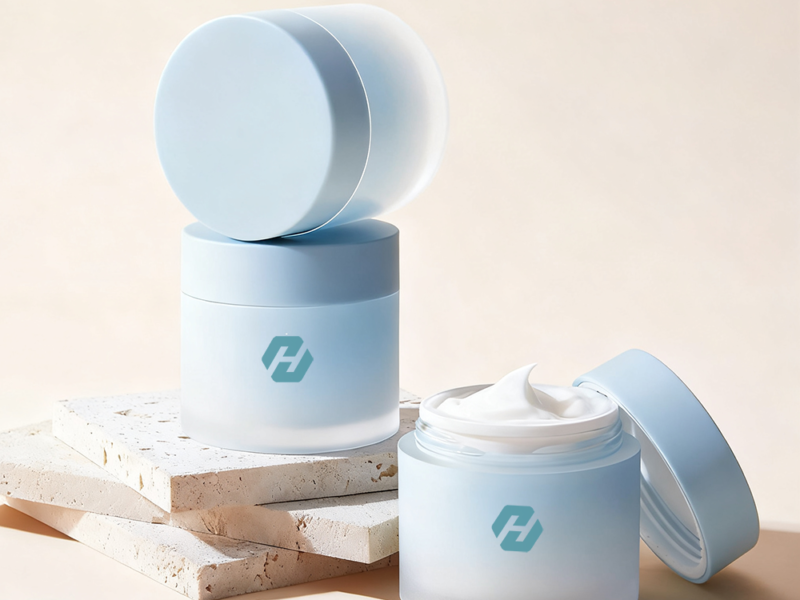
Selecting the primary packaging for a skincare formulation is a critical intersection of chemistry, mechanical engineering, and consumer psychology. While marketing teams often prioritize the “shelf appeal” of a heavy-walled glass jar or the sleek silhouette of a pump bottle, packaging engineers and product formulators must prioritize formula integrity and functional performance.
The choice between a face cream jar vs bottle is rarely arbitrary. It is dictated by the rheological properties of the product—its flow behavior—and the sensitivity of its active ingredients to environmental exposure.
Viscosity and Rheological Considerations
The most fundamental technical constraint in packaging selection is the viscosity of the formulation. Viscosity, measured in centipoise (cP), determines how a product moves through a dispensing system or sits within a container.
When to Specify a Jar for High Viscosity?
Jars are the traditional choice for high-viscosity formulations. Creams with a thick, buttery consistency or “rich” night creams often exceed 50,000 cP. These formulas do not “flow” easily. Attempting to house a high-viscosity cream in a bottle with a standard dip-tube pump often leads to “tunneling,” where the pump clears a path through the center of the product, leaving significant residual waste against the walls of the bottle.
When to Specify a Bottle for Low Viscosity?
Bottles are engineered for low-to-medium viscosity products, typically ranging from 1,000 to 30,000 cP. This includes lotions, fluid emulsions, and lightweight moisturizers. The mechanical advantage of a bottle lies in its controlled dispensing through pumps or droppers, which allows for precise dosing—a crucial factor for high-potency treatments.
Ingredient Integrity and Oxidation Control
Modern skincare often relies on volatile active ingredients like L-ascorbic acid (Vitamin C), Retinol, and various peptides. These compounds are highly susceptible to oxidation and UV degradation.
The Impact of Surface Area Exposure?
A jar, by design, has a wide mouth. Every time a consumer opens a cosmetic jar, the entire surface area of the product is exposed to oxygen and ambient light. This “open-system” packaging can accelerate the degradation of sensitive actives. Furthermore, the practice of dipping fingers into a jar introduces microbial contamination, necessitating a more robust (and sometimes more irritating) preservative system to maintain safety over the product’s lifespan.
Airless Bottle Technology for Active Ingredients?
Bottles, particularly airless cosmetic bottles, offer a “closed-system” environment. Airless packaging utilizes a mechanical piston or a collapsible pouch to dispense the product without allowing air to enter the chamber. This significantly reduces the risk of oxidation and allows formulators to use fewer preservatives or more delicate natural ingredients that would otherwise fail stability testing in a jar format.
| Feature | Cosmetic Jar | Cosmetic Bottle (Pump/Airless) |
| Ideal Viscosity | High (>50,000 cP) | Low to Medium (<30,000 cP) |
| Oxidation Risk | High (Large surface area exposure) | Low (Minimal air contact) |
| Hygiene Level | Low (Direct finger contact) | High (Non-contact dispensing) |
| Product Evacuation | High (Easy to scrape the bottom) | Variable (Airless: 95%+, Dip-tube: ~85%) |
| Filling Process | Top-fill, simpler equipment | Bottom-fill (Airless) or Top-fill |
| Dosing Precision | Manual/Estimated | Measured per stroke (e.g., 0.2cc) |
Manufacturing and Filling Line Considerations
From an OEM/ODM perspective, the choice between a jar and a bottle impacts the production workflow and total cost of goods (COGS).
Filling Speed: Jars are generally easier and faster to fill on a production line. The wide opening allows for high-speed volumetric filling with minimal risk of air bubbles. Bottles, especially those with narrow necks, require more precise nozzle alignment and slower filling speeds to prevent foaming or “crowning” at the neck.
Capping and Torque: Automated capping for bottles often requires sophisticated torque monitoring to ensure the pump mechanism is not damaged while remaining leak-proof. Jars use simpler screw-on or snap-on lids, which are mechanically less complex.
Shipping Stability: Bottles, due to their higher center of gravity, may require more robust secondary packaging (boxes) and dividers to prevent tipping or breakage during transit. Jars, having a lower profile and wider base, are inherently more stable during palletized shipping.
The Consumer Experience: Ergonomics vs. Luxury
The “ritual” of skincare plays a significant role in consumer retention.
The Jar Experience: Is often associated with “luxury” and “self-care.” The act of scooping out a rich cream provides a tactile, sensory experience that many high-end brands leverage. Double-wall acrylic or heavy glass jars provide a “heft” that conveys premium value.
The Bottle Experience: Is rooted in “efficiency” and “clinical precision.” Consumers who prioritize hygiene and speed often prefer bottles. For travel, bottles are generally more convenient, as many modern designs include locking pumps to prevent accidental discharge in luggage.
Sustainability and Material Selection
In the current regulatory climate, the “better” packaging is often the one with the lowest environmental impact.
Glass vs. Plastic: Both jars and bottles are available in glass (highly recyclable, inert) and plastics like PET or PP. However, cosmetic jars are increasingly being designed with refillable inner pods. This allows the consumer to keep the heavy outer jar and simply replace the lightweight plastic insert.
PCR Content: Post-Consumer Recycled (PCR) resins are now standard in bottle manufacturing. While airless bottles are technically complex (often involving multiple materials like springs and pistons), mono-material pump designs are emerging to improve recyclability.
Summary
There is no universal winner in the face cream jar vs bottle debate; the optimal selection depends on formula chemistry and market positioning. Use a jar for high-viscosity, luxury-oriented balms where physical access to the product is essential. Opt for a bottle, specifically airless systems, for fluid emulsions or formulas containing oxygen-sensitive actives like Vitamin C and Retinol to ensure long-term stability and hygienic dosing.
FAQ
1. Can I use an airless bottle for a very thick face cream?
Technically, yes, provided the cream has enough “yield value” to move toward the piston. However, extremely high-viscosity creams may cause the pump to prime poorly. Testing with a specific pump engine is mandatory.
2. Are jars generally cheaper than bottles?
Generally, a basic single-wall jar is more cost-effective than a multi-component pump bottle. However, high-end double-wall jars with specialized coatings can exceed the cost of standard lotion bottles.
3. How do I prevent my jar-based cream from oxidizing?
Consider using an “airless jar” (also known as a press-top jar). These have a flat top with a small dispensing hole; when the user presses down, a small amount of cream is extruded without exposing the entire contents to the air.
4. Which packaging is better for “Clean Beauty” brands?
Bottles, specifically airless versions, are often preferred. Because they limit environmental exposure, brands can use lower concentrations of synthetic preservatives, which aligns with “clean” and “natural” marketing claims.
5. What is the standard lead time for custom-colored packaging?
In the cosmetic packaging industry, standard lead times for customized components typically range from 35 to 50 days, depending on the complexity of the tooling and material selection (PP vs. PETG vs. Glass).
Reference Sources
ISO 22716 Cosmetics Good Manufacturing Practices Guide
FDA Guidance on Cosmetic Packaging and Labeling Requirements